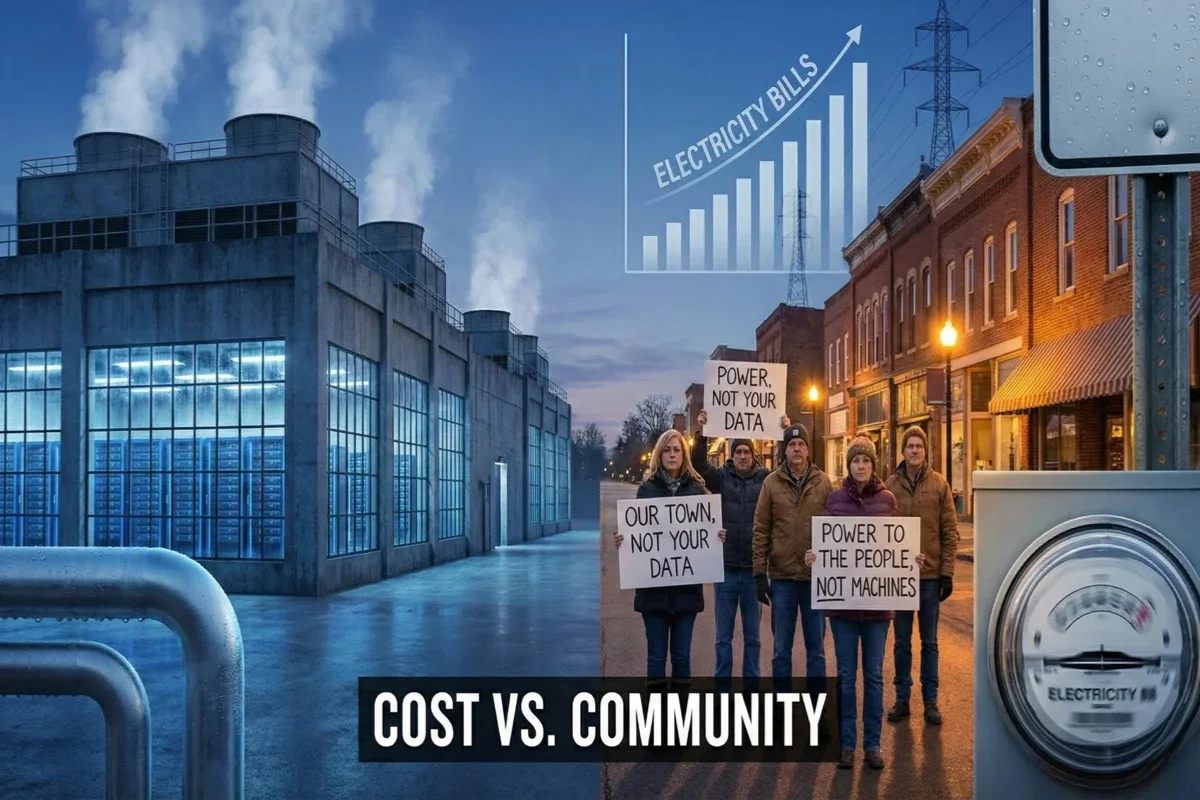
Artificial intelligence is transforming technology at breakneck speed, but it’s also creating an unexpected battleground in small-town America. From Oklahoma to Ohio, communities are rising against massive data centers that promise innovation but deliver skyrocketing utility bills, environmental strain, and minimal local jobs. This backlash has already blocked or delayed $98 billion in proposed data center projects across the United States in 2025 alone, with opposition expected to intensify through 2026.
The conflict isn’t just about infrastructure—it’s about who pays the price for AI’s exponential growth. While tech giants race to build the computational backbone for ChatGPT-style services and enterprise AI, residents in data-center-dense regions are watching their electricity rates climb by 60% or more in just a few years. Understanding why data centers consume so much energy, and how that cost gets passed to everyday Americans, reveals the hidden infrastructure crisis behind AI’s glossy promise.
What Makes AI Data Centers Such Energy Monsters?
High-density AI server racks with NVIDIA GPU trays, NVLink switches, and power shelves
AI data centers consume vastly more electricity than traditional computing facilities because of three core demands: processing power, cooling systems, and 24/7 operation.
Modern AI applications—especially generative tools like ChatGPT—require specialized graphics processing units (GPUs) that can perform trillions of calculations per second. A single ChatGPT query uses 2.9 watt-hours of electricity, nearly 10 times more than a traditional Google search at 0.3 watt-hours. When you scale that to billions of daily queries worldwide, the numbers become staggering: Google’s search engine alone could require an additional 10 terawatt-hours (TWh) annually if AI is fully integrated.
Cooling represents the second-largest energy sink. High-performance GPUs generate intense heat that must be managed continuously to prevent hardware failure. Traditional air-conditioning systems consume 25-40% of a data center’s total electricity, while even optimized liquid-cooling setups still account for 10-15% of total power draw. Compressors alone can use up to 70% of a cooling system’s energy.
The 24/7 operational requirement means data centers never power down. A typical facility consumes as much electricity as 100,000 households, running constantly to serve AI queries, cloud storage, and enterprise applications. By 2026, global data center electricity consumption is projected to exceed 500 TWh annually—roughly 2% of all electricity generated worldwide.
How Data Center Demand Drives Up Your Electric Bill
The electricity crisis isn’t theoretical—it’s showing up in monthly bills across data-center-heavy regions. Here’s how the cost burden shifts from Big Tech to ordinary residents.
Wholesale electricity prices have surged up to 267% in areas near major data centers compared to five years ago. In Central Ohio, which hosts 130 data centers, residential customers like Ken and Carol Apacki saw their rates jump from 12 cents per kilowatt-hour in 2020 to 19 cents in 2025—a 60% increase. Meanwhile, large commercial users (including data centers) saw rates rise by only 2 cents, while residential rates climbed by 8 cents.
This disparity occurs because utility companies negotiate special bulk rates with data center operators while spreading infrastructure upgrade costs across all customers. In northern Virginia—dubbed “data center alley”—Dominion Energy requested rate hikes of $20 per month for average residential users over two years, citing data center demand, inflation, and fuel costs.
A 2025 study from Carnegie Mellon and North Carolina State University estimates that data centers and cryptocurrency mining could increase average electricity bills by 8% by 2030, with spikes exceeding 25% in major data-center markets like northern Virginia. Energy Secretary Chris Wright acknowledged the political volatility: “In rural America right now, where data centers are being built, everyone’s already angry because their electricity prices have risen a lot”.
The Hidden Environmental Costs: Water & Grid Stability
Beyond electricity, data centers create two critical environmental pressures: massive water consumption and grid instability.
Water Consumption in Drought-Prone Areas
Modern data centers use millions of gallons of water annually for evaporative cooling systems. In Colón, Mexico a semi-arid region already facing water shortages—residents are protesting new facilities from Google, Microsoft, and Amazon that represent nearly $10 billion in investment. Court documents revealed Google’s second Chilean data center in Cerrillos could consume 7 billion liters of water annually, enough to supply 80,000 people. Public outcry eventually forced Google to switch from water-based to fan-based cooling in that facility.
Grid Stability Risks
The concentrated power demand from multiple data centers can destabilize regional electricity grids, especially during extreme weather. Cathy Kunkel from the Institute for Economics and Analysis notes that in Central Ohio, “generation costs have surged, partly due to the relentless demand from data centers. The demand exists, but the supply may be lacking”. This imbalance creates brownout risks and forces utilities to bring older, dirtier power plants back online to meet demand.
Why Communities Are Organizing Against Big Tech
Local resistance has coalesced around four core grievances: lack of transparency, broken economic promises, environmental degradation, and political betrayal.
Secret Deals and NDAs
Many communities discovered data center plans only after local officials signed multi-year non-disclosure agreements (NDAs) with tech companies. In Tucson, Arizona, city council members signed a five-year NDA with Amazon that didn’t come to light for two years, fueling voter outrage. In Coweta, Oklahoma, protest signs read “NDAs BETRAY” as residents demanded the firing of officials who signed secret agreements.
Few Permanent Jobs, High Resource Costs
Data centers were marketed as economic development engines, but communities discovered they generate minimal permanent employment while consuming vast public resources. Sand Springs, Oklahoma leaders faced “besieged community anger” after annexing 827 acres of farmland for a data center project negotiated in secret. Residents view these facilities as “operations that benefit from generous incentives, drive up utility costs for communities, and generate few permanent jobs in return”.
Political Impact
Data center opposition is reshaping local elections across swing states. In Virginia’s 2025 gubernatorial race, Democrat Abigail Spanberger won by promising to lower utility bills amid steep rate hikes voters blamed on the data-center boom. This tension intersects with Trump’s broader big tech regulation stance, which has added another layer of complexity to the political debate. In Georgia, Democrats secured their first seats on the state utility regulatory commission since 2007, driven by similar concerns. One analyst noted, “It will be intriguing to observe how this opposition shapes the regulatory landscape” as midterm elections approach in 2026.
The Numbers Behind the Backlash
| Metric | Impact | Source |
|---|---|---|
| Blocked/Delayed Projects (2025) | $98 billion in proposed investments | theverge |
| Energy Consumption (2026 est.) | 500+ TWh globally (2% of world electricity) | ttms |
| Bill Increase (Central Ohio) | 60% residential rate hike (2020–2025) | npr |
| ChatGPT Query Energy | 2.9 Wh (10× traditional Google search) | datacenterfrontier |
| Typical Facility Power Draw | Equivalent to 100,000 households | time |
| Projected Bill Increase by 2030 | 8% average; 25%+ in data-center hubs | usatoday |
| Water Use (Google Chile) | 7 billion liters/year (supplies 80k people) | nearshoreamericas |
What’s Next for AI Infrastructure?
The collision between AI ambition and community resistance represents a fundamental challenge to America’s tech leadership. TIME Magazine’s February 2026 analysis warns that “popular opposition to data centers is likely the canary in the coal mine” for broader AI skepticism. Without addressing electricity costs, water scarcity, and transparency failures, the political viability of large-scale AI infrastructure remains uncertain.
Some solutions are emerging: liquid cooling technologies can reduce facility power consumption by 18.1% compared to traditional air cooling, and AI-driven thermal management systems optimize energy use in real-time. However, these efficiency gains still lag behind the explosive growth in AI computational demand—companies are reporting year-over-year increases exceeding 100% in AI computing power.
The hardware arms race compounds the problem. As covered in our CES 2026 chip wars analysis, NVIDIA, AMD, and Intel are all racing to produce more powerful AI accelerators, which inevitably consume more electricity even as per-watt efficiency improves. The paradox: better chips enable more AI applications, which drives demand for more data centers, perpetuating the cycle.
The backlash is not a rejection of innovation but a demand for accountability. Communities want to know if AI’s benefits can be delivered without sacrificing environmental integrity, grid stability, and affordable electricity. As one protest organizer in Oklahoma put it: “This town deserves a better centerpiece than a data center. They keep coming to smaller and smaller towns. Leave mine alone”.
- Anthropic Hits $350B Valuation: The Anthropic Claude vs ChatGPT Enterprise 2026 Migration

- Claude Code leak Anthropic: Crisis Exposed & Impact on US Devs

- Fix iPhone DarkSword iOS 18: Stop the Silent Hack Now

- OpenAI Sora Shut Down: Why The Top AI Video App Is Dead

- 10 US Platforms Exploding Now: The AI SaaS Tools 2026 List