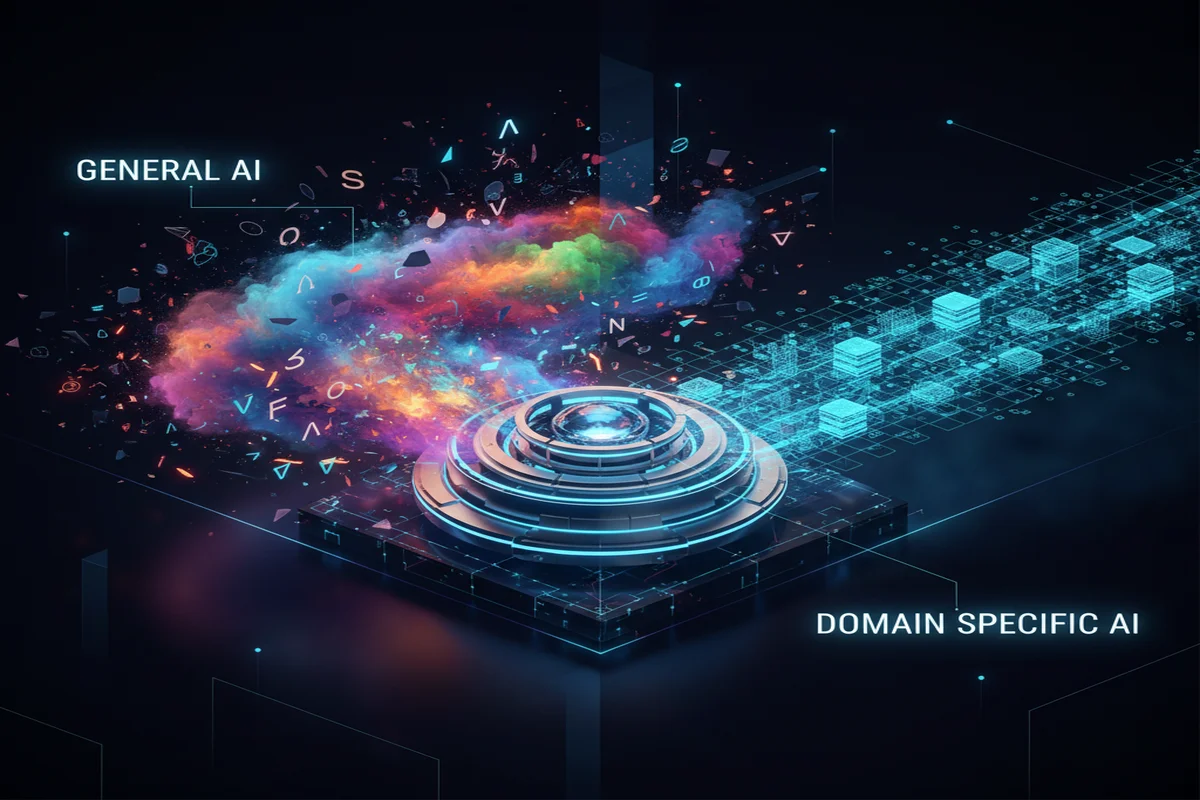
While 2024 and 2025 were the years of massive, general-purpose AI like GPT-5 and Gemini 3, 2026 has ushered in a more practical era: the rise of specialized intelligence. For enterprise leaders, the “one-size-fits-all” approach is officially dead. Domain specific language models (DSLMs) are replacing general giants in boardrooms, hospitals, and legal firms, offering a solution to the critical “hallucination vs. utility” gap that stalled so many pilot programs last year.
Why the shift? Because general models are jacks of all trades but masters of none. In high-stakes industries where a 1% error rate is unacceptable, businesses are finding that smaller, sharper models trained on vertical data aren’t just better—they are the only viable path forward.
What Are Domain-Specific Language Models?
A domain specific language model is an AI system trained or fine-tuned exclusively on data relevant to a particular industry or vertical. Unlike a general Large Language Model (LLM) like Claude or GPT, which learns from the entire internet (including Reddit threads and fan fiction), a DSLM learns only what matters to its job.
For example, a medical DSLM is trained on PubMed journals, clinical trials, and patient records. It doesn’t know how to write a poem about pirates, but it can diagnose a rare condition with 25-30% higher accuracy than a general model. This focus allows the model to “speak the language” of the industry, understanding complex jargon and context that general models often miss or misinterpret.
The Strategic Edge of Domain Specific Language Models
The migration to specialized models isn’t just a technical preference; it’s a financial imperative. Here is why CTOs are pivoting their stacks in 2026:
1. Radical Cost Reduction
Running a massive general model for niche tasks is like using a Ferrari to deliver mail—expensive and inefficient. General models often cost significantly more per inference due to their sheer size.
- Infrastructure: DSLMs often have fewer parameters, meaning they require less GPU power to run.
- Scale: For high-volume tasks, fine-tuned smaller models can reduce inference costs by over 45% compared to calling a general API.
2. Superior Accuracy and Reduced Hallucinations
General models are prone to “hallucinations”—confidently stating false facts. In a legal contract review, a hallucination is a liability. DSLMs, bounded by their curated training data, are far less likely to invent facts. Studies from late 2025 show that legal-specific models reduced processing time by 30% while significantly cutting error rates compared to general LLMs.
3. Data Privacy and Governance
Sending proprietary data to a third-party general model API (like OpenAI or Google) remains a compliance nightmare for banks and defense contractors. DSLMs can be hosted entirely on-premise or in a private cloud (VPC), ensuring that sensitive data never leaves the organization’s control.
Comparison: General LLMs vs. Domain-Specific Models
The following table breaks down why the enterprise market is shifting:
| Feature | General LLM (e.g., GPT-5, Claude) | Domain-Specific Model (DSLM) |
|---|---|---|
| Training Data | The entire internet (General) | Curated industry data (Vertical) |
| Accuracy (Niche) | Moderate; prone to hallucinations | High; expert-level precision |
| Cost | High per-token cost | Low inference cost |
| Deployment | Mostly API (Cloud) | Flexible (Edge, On-prem, Private Cloud) |
| Best For | Creative writing, coding, general Q&A | Compliance, diagnostics, risk analysis |
Future Outlook: The “Specialist” Ecosystem
Gartner predicts that by 2027, over 50% of enterprise AI models will be domain-specific. We are moving toward a “Master of One” economy, where businesses will likely employ a constellation of small, specialized models—one for HR, one for Legal, one for Code—rather than a single monolithic brain.
For leaders, the message is clear: Stop trying to force a generalist AI to be a specialist. If you want to build a defensible moat in 2026, build or buy a model that knows your business as well as your best employee does.
📚 Further Reading
- Vercel v0 AI Code Generator: Ship Next.js MVPs Faster [2026 Check]

- Anthropic Hits $350B Valuation: The Anthropic Claude vs ChatGPT Enterprise 2026 Migration

- Claude Code leak Anthropic: Crisis Exposed & Impact on US Devs

References & Sources
- Cogent Info (2025). Domain-Specific Language Models (DSLMs): The End of the General-Purpose LLM Hype in 2026. (Data on cost reduction).
- GoMagentic (2025). Domain LLM vs. GPT-4: Accuracy vs. Cost in the Enterprise AI Landscape. (Vertical data definitions).
- Averi AI (2025). Why Domain-Specific AI Will Beat General AI In Enterprise. (Privacy and On-premise deployment).
- Prolifics (2025). Gartner 2026 Technology Trends – Win The Next Tech Wave. (Error rate contexts).
- Quantilus (2025). The Rise of Domain-Specific AI: What It Means for Your Business. (2027 Market predictions).
- Label Your Data (2025). SLM vs LLM: How to Pick the Right Model Size. (Inference cost analysis).