
Tesla Roadster: What We Know About Price, Specs and Release Date
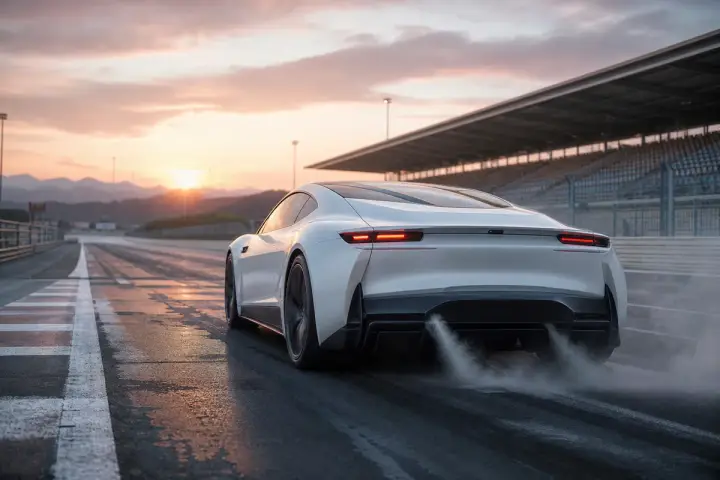
The Tesla Roadster is one of the most-searched names online this week, and for once the buzz has a clear trigger. Tesla finally unveiled the car in a livestream on October 15, 2026, after several postponed dates, and the details raise as many questions as they answer.
Here is what Tesla has actually confirmed about the Tesla Roadster’s price, specs and release date, plus the parts that remain claims or blanks. Most of the details below come from Electrek’s report on the unveiling. If you read Portuguese, there is also a Portuguese-language version for Brazilian readers written for that audience.
Three Trims, Very Different Cars
Tesla did not show one car. It showed three trims, and two of them are add-ons to the first.
- Performance: the road-ready version, with two seats, active aerodynamics and what Tesla calls a “multi-mode suction system.” Tesla claims 0-60 mph in under 1.6 seconds. It is sold by reservation.
- Thrust: a race-ready, two-seat version with rear cold-gas thrusters. Tesla claims 0-60 mph in under 0.9 seconds. It is a limited release.
- Rocket: a one-seat version with thrusters around the perimeter for upward and rotational movement. Tesla claims 0-60 mph in under 0.59 seconds and a top speed above 230 mph. It is invite only, and Tesla’s own page says it is not approved for public roads.
Thrust and Rocket are described as “augments” to the Performance car, so the Performance trim is the one most buyers would be talking about.
How the Thrusters and Suction Are Supposed to Work
The thrusters use compressed gas stored in carbon-fiber overwrapped pressure vessels. Tesla says they work in the atmosphere and deliver four to five times the force the tires can handle, which is the whole point: the gas pushes where rubber would simply lose grip.
The Performance car leans on air instead. Tesla says its suction fans could hold the car upside down. In Track Mode the car lowers itself and deploys active wings, driven by actuators developed for Tesla’s Optimus robot, with downforce Tesla says approaches Formula 1 levels. That last number is unverified, like every performance figure in this article.
Design and Interior
The styling is a clear break from a typical Tesla. Headlights are hidden, a single taillight runs the full width of the car, and the launch paint is called “Ano White.” The windows are tinted like a spacesuit visor. Inside, there is a yoke with steer-by-wire and a center touchscreen, and the materials list includes magnesium, titanium and carbon fiber.
Range, Price and the Reservation Trap
Tesla quotes a range of “over 300 miles,” without saying which trim that applies to. The 2017 prototype promised 620 miles, so range is one of the places where the car got less ambitious.
Pricing is the part that trips people up. Tesla has not announced a price for any trim. What it did announce is a reservation structure:
- $5,000 is due immediately, and Tesla calls it fully refundable.
- $45,000 more is due within 10 days, or the reservation is canceled.
- The total is $50,000, the same figure Tesla asked for in 2017.
That $50,000 is a deposit to hold a spot, not a sticker price. With no final price for any version, nobody can say yet what the car will cost.
Release Date: “2028, Actually”
There is no official production date. When asked, Elon Musk reportedly offered only “2028, actually.” That is a hint, not a commitment, and this car has a long record of missing dates. The 2017 prototype promised production in 2020. The new unveiling itself slipped through several announced dates this year, including April, late April, August and October 1.
Then and Now: What Changed Since 2017
| 2017 prototype | 2026 unveiling | |
|---|---|---|
| Production promise | 2020 | “2028, actually” |
| Range | 620 miles | Over 300 miles |
| Top speed | 250+ mph | 230+ mph (Rocket only) |
| Seating | 2+2 | At most two seats |
| 0-60 mph | 1.9 s | Under 1.6 s (Performance) |
The headline acceleration claim improved, while range, top speed and seating all came down.
How It Compares With Other Hypercars
Without leaning on specific numbers, the picture is easy to describe. Electric performance cars from Porsche, Lucid and Rimac already exist or are on sale, and buyers can drive them today. The Roadster’s pitch is different: it promises headline acceleration that goes beyond what tires alone allow, using thrusters and suction. Whether those systems work as described, hold up in daily use and pass regulators outside the Performance trim is the open question. Until independent testers get one, treat every figure as Tesla’s own.
Should You Reserve One?
Only you can decide that, and this is not financial advice, but the facts above frame the decision.
- The first $5,000 is described by Tesla as fully refundable, but the next $45,000 is due within 10 days, so read the exact terms before you pay.
- No trim has a price, and delivery is, at best, around 2028.
- The Rocket is not approved for public roads, and Thrust is a limited, race-oriented release.
- Electrek’s author, who discloses holding two Founders Series Roadster referral awards, expects the stunt-capable trims to sell in small numbers.
What to Watch Next
Keep an eye out for an official price per trim, a firm production date, independent testing of the 0-60 and downforce claims, and any road-legal approval for the thruster versions. Also watch whether Tesla specifies which trim delivers the 300-plus miles of range.
Viral moments tend to blur the line between a product and a promise. If you like tracking what is trending, our guides to the 3D figurine AI trend and the split-face AI family trend show how fast a topic can spike. For another Musk-linked story where the claims run ahead of the proof, see our Grok Imagine 2.0 prompts guide, and for the AI side of the industry see the GPT-6 Astra release breakdown.