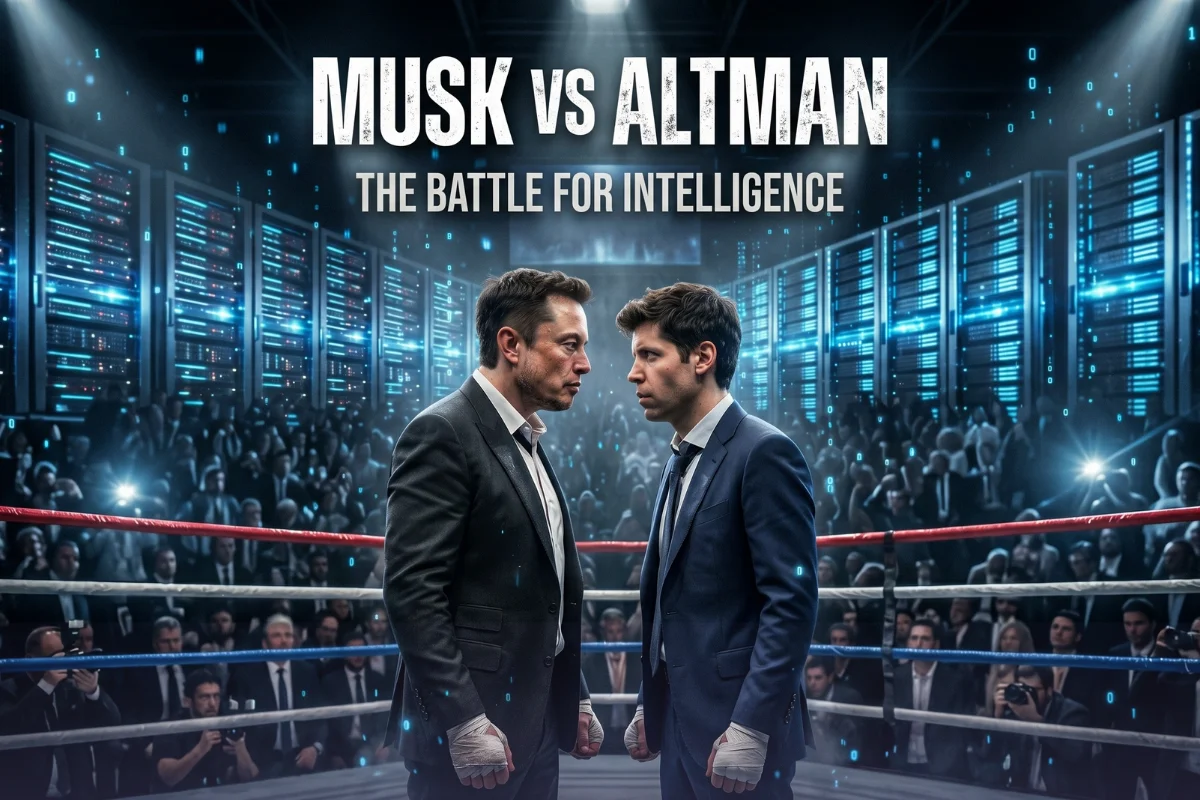
The Musk vs Altman OpenAI 2026 feud just got a verdict, and it did not go the way half of Silicon Valley expected. [Editorial note: lead with the jury outcome since it is the newest, most search-relevant fact.]
A federal jury in Oakland sided with Sam Altman in May, but Elon Musk is already calling the result a technicality and promising an appeal. That means the war everyone thought was ending is actually just entering round two.
This is not a random courtroom footnote for anyone who builds on top of AI models. The case dragged internal 2017 emails, sworn testimony, and OpenAI’s entire corporate structure into public view. In this breakdown, you get the verdict, the leaked evidence behind it, and what it means for your AI stack going into the second half of 2026.
Why the Musk vs Altman OpenAI 2026 Verdict Surprised Everyone
The jury did not rule on whether Altman betrayed OpenAI’s founding mission. It ruled that Musk waited too long to sue.
Musk first raised these complaints back in 2024, years after he reportedly knew Microsoft had effectively taken over OpenAI’s direction. Lawyers for OpenAI used a 2020 post from Musk’s own X account, where he wrote that OpenAI was “essentially captured by Microsoft,” to argue the statute of limitations had already run out.
The jury agreed. Every claim Musk brought against Altman, Greg Brockman, and Microsoft was dismissed on that technical ground alone. [Note: this is a procedural loss, not a ruling on the ethics question, and that distinction matters for the FAQ below.]
Musk responded on X within hours, calling the decision a “calendar technicality” and confirming an appeal is already in motion through his attorney, Marc Toberoff.
What the 2017 Leaked Emails Actually Show
Long before the verdict, the emails were the real story. Internal messages from 2017 surfaced showing Greg Brockman privately acknowledging that OpenAI’s leadership was not fully committed to staying a nonprofit forever.
That detail became central to Musk’s case. He argued his original $38 million donation came with two conditions: OpenAI would remain nonprofit, and its technology would stay open source.
OpenAI’s lawyers pushed back hard in court, stating Musk himself had pushed for a for-profit structure on the condition that he retained control, even floating a plan to fold OpenAI into Tesla. That single fact undercut Musk’s “betrayed idealist” narrative in front of the jury.
Actionable Steps to Protect Your AI Infrastructure
An appeal means this instability is not over. Treat the next few months as a live risk window for anything built on OpenAI’s platform.
✅ Audit your API reliance: Map every core feature in your product that depends entirely on OpenAI’s models. If you need a starting framework, check out our ChatGPT for Marketing Guide.
✅ Deploy open-source fallbacks: Integrate models like Llama or Mistral as secondary engines for critical workflows. Our Deepseek V4 vs ChatGPT Comparison breaks down strong alternatives.
❌ Stop assuming stability: Corporate governance fights like this one tend to resurface with each appeal, so do not build your roadmap around the assumption that this is settled.
⏱️ Track the appeal timeline: Toberoff has confirmed the appeal is coming, and appellate review could stretch well into 2027.
Comparing the Visions: Profit vs Open Source
The underlying disagreement has not changed just because the jury ruled. Musk still wants a decentralized, tightly regulated approach to AGI. Altman is still scaling as fast as capital allows.
| Feature/Metric | 🚀 Elon Musk’s Vision | 💼 Sam Altman’s Strategy |
|---|---|---|
| Core Philosophy | Open-source, decentralized control | Proprietary, heavily capitalized scaling |
| Corporate Structure | Strict nonprofit foundation | Capped-profit corporate hybrid |
| Safety Approach | Pause advanced training, regulate now | Deploy iteratively, fix safety in real time |
| Legal Status (Aug 2026) | Lost on statute of limitations, appealing | Verdict favorable, restructuring continues |
| Endgame Goal | Prevent corporate AI monopolies | Achieve AGI through massive compute power |
| Market Impact | Drives Grok and xAI adoption | Dominates enterprise software integrations |
Why This Fight Still Changes Everything
A procedural win is not the same as vindication, and that gap is exactly why the Musk vs Altman OpenAI 2026 story refuses to die. The jury never touched the actual ethics question: did OpenAI abandon a charitable mission to chase a trillion-dollar valuation?
That question now moves to an appellate court, with OpenAI’s restructuring and its multibillion-dollar Microsoft partnership sitting in the background the entire time. Enterprise buyers watching this case are not asking who wins. They are asking whether OpenAI’s governance is stable enough to build a five-year roadmap on top of it.
If the appeal reopens any of these claims, the pressure on OpenAI’s for-profit structure returns immediately, and so does the uncertainty for every developer relying on its API.
FAQ
Did Elon Musk win his lawsuit against Sam Altman? No. A jury ruled in OpenAI’s favor in May 2026, finding Musk’s claims were filed too late under the statute of limitations. The ruling did not address whether Altman actually breached OpenAI’s founding mission.
Is Elon Musk appealing the OpenAI verdict? Yes. Musk called the ruling a “calendar technicality” on X, and his attorney Marc Toberoff confirmed an appeal is already underway.
What did the leaked 2017 emails reveal? Internal messages showed OpenAI co-founder Greg Brockman privately acknowledging the company was not fully committed to remaining a nonprofit, years before Musk’s lawsuit was filed.
Is Microsoft still involved in the lawsuit? Yes. Microsoft was named as a co-defendant, accused of aiding OpenAI’s alleged breach of charitable trust through its investment and Azure partnership. That claim was also dismissed with the rest of the case.
Does this affect apps built on OpenAI’s API? Indirectly. The case does not change API access today, but a pending appeal keeps OpenAI’s governance and structure under a legal cloud that enterprise teams should factor into vendor risk planning.
The Bottom Line
The Musk vs Altman OpenAI 2026 saga just proved that a jury verdict is not the same thing as closure. Musk is appealing, the ethics question is still unresolved, and OpenAI’s for-profit structure remains a legal target.
Audit your dependencies now, diversify where you can, and treat this appeal as the next data point, not the final one. Subscribe to our daily tech briefing below to get the appellate updates as soon as they break.
- Google Flow Camera Commands: 40 Prompts to Steal Right Now

- Moltbook AI Agent Network: Inside the Social Platform Built for Bots

- macOS vs Windows Security: Which One Actually Keeps You Safer in 2026?

- Security+ Passing Score Explained: How Many Questions Can You Miss?

- Musk vs Altman OpenAI 2026: The Leaked Emails War